Sign inJoin
TesoroDigital

The Spanish learner's gazette

Valencia EditionNº 2026
← Featured Tutors
Z

A1 + A2 · Learn with Zully

Ser y estar con Zully

Who you are, how you feel, and your life in Valencia.

Adapted from Zully’s teaching material, with additional practice exercises and reviewed grammar notes.

Preply
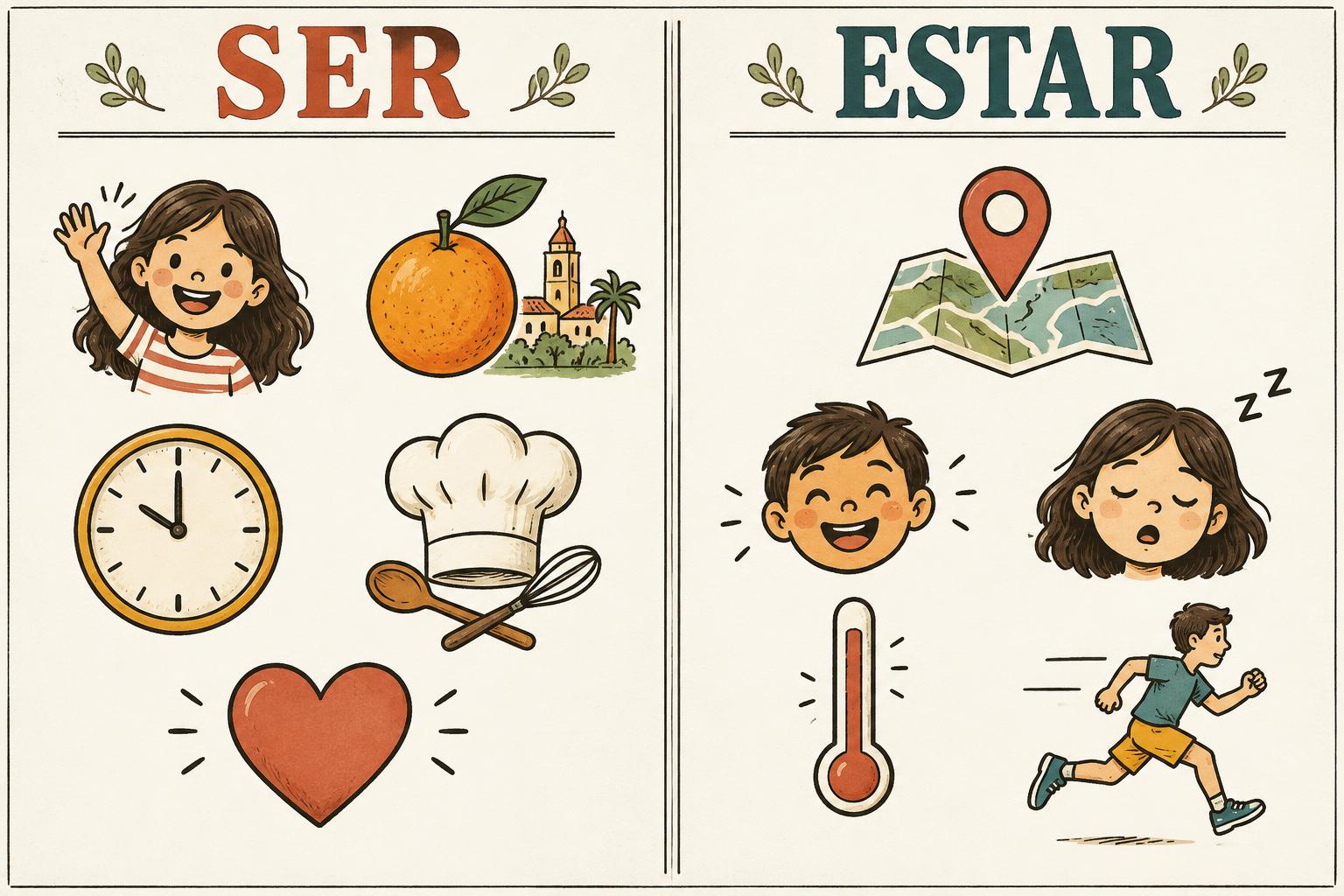
Ser and estar illustrated with identity, origin, feelings and location
SER: identity and characteristics. ESTAR: location and state.

Your reference table

PersonSERESTAR
yosoyestoy
túeresestás
él / ella / ustedesestá
nosotros / nosotrassomosestamos
vosotros / vosotrassoisestáis
ellos / ellas / ustedessonestán

It is not simply permanent versus temporary: la escuela está en Valencia; la fiesta es en el parque. Soy consciente can describe being mindful; estoy consciente describes being conscious or awake.

SER · DOCTOR

Description
Yo soy alto. Soy inteligente.
I am tall. I am intelligent.
Occupation
Soy profesora. Soy estudiante.
I am a teacher. I am a student.
Characteristic
El coche es rojo.
The car is red.
Time / date
Hoy es martes. Son las tres.
Today is Tuesday. It is three o’clock.
Origin
Soy de Estados Unidos. Soy americano.
I am from the United States. I am American.
Relationship
Ella es mi mamá. Él es mi amigo.
She is my mum. He is my friend.

ESTAR · PLACE

Position
El libro está en la mesa.
The book is on the table.
Location
Estoy en clase. Estoy en casa.
I am in class. I am at home.
Action in progress
Estoy hablando. Estoy comiendo.
I am speaking. I am eating.
Condition
Estoy cansada. Estoy enfermo.
I am tired. I am ill.
Emotion
Estoy feliz. Estoy triste.
I am happy. I am sad.

Your Spanish, your story

Your story and answers are saved only on this device. They are not sent to Zully.

From “hola” to a conversation

Hola. Soy Alex. Soy de Colombia. Soy estudiante. Hoy estoy en Valencia. Estoy feliz. Estoy practicando español. Quiero aprender más. Me gusta pasear. ¿De dónde eres?

You have just met someone at a café. Say hello, introduce yourself, share an interest and ask them a question.

New friends introducing themselves at a sunny Valencia café
«Hola, soy Lucía. ¿Puedo sentarme aquí?»
One question can start a new friendship.

More verbs for your day

Tener = to have · Hacer = to do / make · Querer = to want / love. Hace is a form of hacer; quiero is a form of querer.

PersonTenerHacerQuerer
yotengohagoquiero
tútieneshacesquieres
él / ella / ustedtienehacequiere
nosotros / nosotrastenemoshacemosqueremos
vosotros / vosotrastenéishacéisqueréis
ellos / ellas / ustedestienenhacenquieren

Tengo que trabajar. Hago la tarea. Hace calor. Quiero aprender español.

Gustar

The form agrees with what is liked, not the person: me gusta el fútbol / me gusta jugar; me gustan los partidos.

Who likes itSingular / infinitivePlural
a míme gustame gustan
a tite gustate gustan
a él / ella / ustedle gustale gustan
a nosotros / nosotrasnos gustanos gustan
a vosotros / vosotrasos gustaos gustan
a ellos / ellas / ustedesles gustales gustan

Poder · Ability and permission

Poder means “can / to be able to”. It agrees with the person and takes an infinitive: puedo hablar, not puedo hablo. Unlike gustar, it does not agree with the thing or activity.

PersonPoderExample + infinitive
yopuedoPuedo hablar contigo.
túpuedes¿Puedes repetir, por favor?
él / ella / ustedpuede¿Puede ayudarme?
nosotros / nosotraspodemosPodemos practicar juntos.
vosotros / vosotraspodéis¿Podéis venir mañana?
ellos / ellas / ustedespuedenPueden hablar español.

¿Puedo sentarme aquí? · ¿Puedes repetir, por favor? · Podemos practicar juntos.

Essential vocabulary

0/19 learned

1/19

tener que

Tengo que practicar español.

Full vocabulary list
tener que
to have to
Tengo que practicar español.
I have to practise Spanish.
tener ganas de
to feel like
Tengo ganas de jugar.
I feel like playing.
querer
to want / to love
Quiero aprender español.
I want to learn Spanish.
hacer
to do / to make
Hago la tarea.
I do my homework.
gustar
to like (literally: to please)
Me gusta el fútbol.
I like football.
poder
can / to be able to
¿Puedes hablar más despacio?
Can you speak more slowly?
cuando
when
Cuando termina el partido, vamos a casa.
When the match ends, we go home.
hinchada
supporters / fanbase
La hinchada anima al equipo.
The supporters cheer on the team.
delantero
striker / forward
El delantero es muy listo.
The striker is very clever.
entrenador
coach
El entrenador está orgulloso.
The coach is proud.
árbitro
referee
El árbitro es atento.
The referee is attentive.
grada
stands
Estoy gritando en la grada.
I am shouting in the stands.
pelota
ball
Los jugadores están atentos a la pelota.
The players are paying attention to the ball.
novato
beginner / rookie
El jugador es novato.
The player is a rookie.
ganar
to win / to earn
El equipo quiere ganar.
The team wants to win.
necesitar
to need
Necesitamos tres puntos.
We need three points.
agotado
exhausted
Después del partido estoy agotado.
After the match I am exhausted.
orgulloso
proud / haughty (context matters)
Estoy orgulloso de mi equipo.
I am proud of my team.
molesto
annoyed (estar) / annoying (ser)
Estoy molesto porque el ruido es molesto.
I am annoyed because the noise is annoying.

CAN · COULD · WILL · WOULD

One question opens a conversation

Ability, requests, plans and invitations. Combine familiar verbs with ready, nervous, free, tired and friendly.

Can · poder A1
Ask about ability or permission with poder + infinitive.
¿Puedes estar listo a las seis?
Can you be ready at six?
Will · future plans A1 → A2
Use ir a + infinitive for plans. The simple future also works: ¿Qué harás mañana? Spanish has no separate word that always means “will”.
¿Vas a hacer la cena mañana?
Will you make dinner tomorrow?
Friends asking questions at a Valencia café
¿Te gustaría practicar conmigo?
Would you like to practise with me?

Build the question

0/4 solved

1/4 · A1

Arrange a meeting with a new friend.

Can you be ready at six?

¿…?

Choose the right form

1. Can you be ready? · ¿Puedes ___ listo?

Introduce yourself, describe how you feel, ask a question with puedes and another about a plan with vas a.

SER · ESTAR · TENER · HACER · QUERER · GUSTAR · PODER · HARÉ

Conversations with strangers

A1 · Hola, ¿qué tal?

— Hola, soy Alex. Soy de Colombia. ¿Y tú?

— Soy Lucía. Soy de Valencia. ¿Cómo estás?

— Estoy bien, gracias. Soy estudiante. Me gusta cocinar. ¿Qué te gusta hacer?

— Me gusta pasear. ¿Quieres caminar?

— Sí, tengo tiempo. ¿Puedes hablar despacio, por favor?

— Claro. Podemos practicar juntos.

1. A stranger says: «Hola, soy Marta». What is a friendly reply?
2. You want to ask permission to sit down.
3. You did not understand. Keep the conversation going.

Ready to combine more verbs?

Reading & practice

0/3 parts completed

Quién soy y cómo estoy

Traits & states

Soy vegana / vegano.

I am vegan.

Estoy feliz / alegre.

I am happy / joyful.

Soy activista.

I am an activist.

Estoy cansada / cansado.

I am tired.

Soy consciente de mis decisiones.

I am mindful of my decisions.

Estoy preocupada / preocupado.

I am worried.

Soy libre.

I am free.

Estoy libre.

I am available.

Soy independiente.

I am independent.

Estoy motivada / motivado.

I am motivated.

Soy apasionada / apasionado.

I am passionate.

Estoy inspirada / inspirado.

I am inspired.

Soy tranquila / tranquilo.

I am a calm person.

Estoy ansiosa / ansioso.

I am anxious.

Soy fuerte.

I am strong.

Estoy lista / listo.

I am ready.

Soy melancólica / melancólico.

I am melancholic by nature.

Estoy aburrida / aburrido.

I am bored.

Soy gruñona / gruñón.

I am a grumpy person.

Estoy triste.

I am sad.

Soy amargada / amargado.

I am a bitter person.

Estoy agotada / agotado.

I am exhausted.

Soy creativa / creativo.

I am creative.

Estoy nerviosa / nervioso.

I am nervous.

Choose & check

1. Yo ___ de Estados Unidos.
2. Mi jefe ___ holandés.
3. Hoy ___ cansada.
4. Nosotros ___ estudiantes.
5. ___ las tres.
6. Ella ___ mi amiga.

A2 · Reading exam

La crónica del partido

Based on Zully’s second document. Answer in Spanish.

Minuto a minuto

Minuto 0

El estadio es verde, pintado completamente de color verde porque es el color tradicional de la hinchada.

Minuto 1

Los jugadores están verdes: son completamente novatos y tienen que manejar la presión de la hinchada desde el primer segundo.

Minuto 30

Uno de los delanteros es muy listo, pero el entrenador dice que aún no está listo físicamente para jugar todo el partido.

Minuto 35

El equipo tiene que ganar hoy porque quiere clasificarse para el torneo internacional y necesita sumar tres puntos. El equipo tiene ganas de demostrar su nivel.

Minuto 40

Estoy gritando en la grada porque el partido está muy emocionante.

Minuto 45

El árbitro es una persona muy atenta y educada por naturaleza, pero los futbolistas están muy atentos a la pelota en cada jugada.

Minuto 60

Los aficionados están molestos con el árbitro porque pitó un penalti injusto. Para ellos, esta decisión es muy molesta.

Minuto 65

El director técnico está orgulloso del esfuerzo de su equipo, aunque es un hombre muy orgulloso que nunca acepta sus errores.

Minuto 90

Cuando finaliza el partido, el estadio está libre para el siguiente evento, y el equipo visitante es libre de celebrar la victoria.

Está muy emocionante highlights the match as experienced now; es emocionante is also natural when describing it. Here we follow Zully’s text.

Your answers

ser / estar + verde

ser / estar + listo

tiene que + infinitivo · quiere · necesita

tener ganas de + infinitivo

estar + gerundio

ser / estar + atento

ser / estar + molesto

ser / estar + orgulloso

ser / estar + libre

0/9 answers self-reviewed

Model answers are examples, not automatic marking. Other complete answers can also be correct.

Check your understanding

1. El estadio ___ verde: es su color.
2. Los jugadores ___ verdes: son novatos.
3. El delantero es inteligente, pero no ___ listo físicamente.
4. El equipo ___ que ganar.
5. El equipo ___ clasificarse para el torneo.
6. El equipo tiene ganas ___ demostrar su nivel.
7. Ahora ___ gritando en la grada.
8. Los futbolistas ___ atentos a la pelota.
9. La decisión ___ molesta para los aficionados.
10. El entrenador ___ orgulloso del esfuerzo de su equipo.
11. A mí me ___ el fútbol.
12. ___ finaliza el partido, el estadio está libre.

Your homework for Zully

Where are you from, what is your nationality, and what do you do?

How are you today, and where are you now?

What are you doing now, apart from this homework?

What do you like doing in your free time?

What do you have to do this week, and what do you want to do on your next trip?

Would you like to practise your answers in a lesson with Zully?

Preply